
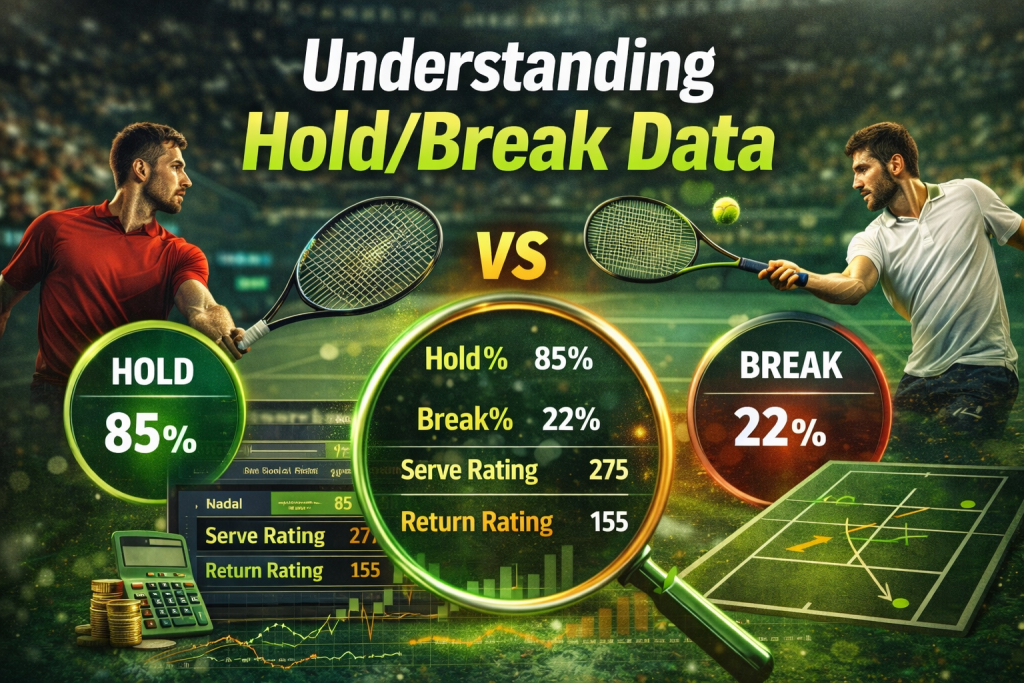
Service hold and break percentages are among the most powerful metrics in tennis analysis, yet they are often misunderstood or oversimplified by bettors. At their core, these figures measure how frequently a player holds serve and how often they break their opponent’s serve but their true value lies in how they are contextualised.
A player’s hold percentage reflects the reliability of their serve under match conditions, while break percentage indicates return effectiveness. Together, these metrics provide a clearer picture of a player’s baseline dominance than win–loss records alone. However, raw numbers can be misleading. A 85% hold rate accumulated on fast hard courts does not translate directly to clay, just as strong break numbers against weaker opposition may inflate perceived ability.
This is why opponent-adjusted hold and break data is essential. By blending a player’s service and return performance with the quality of opponents faced, analysts can separate genuine skill from schedule-driven variance. Surface adjustment further refines this view, accounting for slower courts, bounce height, and rally length that materially affect service dynamics.
Hold/break data is particularly valuable in in-play betting. Markets often react sharply to a single break of serve, even when the underlying numbers suggest the break was statistically likely or temporary. Identifying players with historically strong break-back tendencies or resilient service games allows bettors to avoid overreacting to short-term scoreline changes. Importantly, hold and break percentages are not predictive in isolation. They should be interpreted alongside pressure-point performance, break-point conversion rates, and variance metrics to understand sustainability.
Used correctly, hold/break data shifts betting analysis away from narratives and towards probability providing a more stable foundation for identifying value in both pre-match and in-play tennis markets.