
General Tennis Articles
Home Advantage in Tennis: Does It Really Exist?
Home advantage is a well-documented phenomenon in team sports, generally attributed to crowd support, travel reduction, and familiarity with conditions.

Home advantage is a well-documented phenomenon in team sports, generally attributed to crowd support, travel reduction, and familiarity with conditions.

In-play tennis trading (see Day 6) moves quickly, and the psychological pressures involved differ meaningfully from the more measured pace

Building on the general surface overview from Day 4, this article takes a closer, more statistical look at how each

Commentators and bettors alike often describe certain players as “streaky” — prone to extended hot and cold runs of form.

Tennis statistics tables — whether from an official tour source, a broadcast graphic, or an analytics platform — can look

Tennis is one of the most physically and logistically demanding sports on the professional calendar, and fatigue — both short-term

Market efficiency comes from financial economics and now plays a central role in serious sports betting. It helps explain where

Tiebreaks occupy a unique statistical space in tennis — short, high-pressure mini-matches embedded within a larger one, with their own

Unlike many indoor sports, tennis often takes place outdoors. Environmental factors such as wind, temperature, and humidity can affect performance,

Even the most statistically sound approach to tennis betting can be undermined by poor bankroll management. This is one of

Closing line value (CLV) is one of the most respected long-term performance metrics used by serious sports bettors — arguably

Beneath the ATP and WTA main tours sits the Challenger Tour (men’s) and the equivalent lower-tier WTA circuit — a

While the ATP (men’s) and WTA (women’s) tours share the same fundamental rules and scoring system, statistical patterns across the

Break points are among the most pivotal moments in a tennis match, and break-point statistics are among the most frequently

“Momentum” is one of the most commonly used — and most debated — concepts in tennis broadcasting and betting. Commentators

Elo-style systems rank among the most widely used approaches to rating tennis players. Chess originally developed the Elo system to

People often use “betting model” loosely. A genuine statistical model follows a clear, repeatable process. It uses historical and current

In-play (or “live”) tennis trading means buying and selling positions on a match while it unfolds, typically through a betting

Before any statistical model or rating system becomes useful, a bettor needs to be fluent in how odds work. This

Tennis is unusual among major sports because players compete on genuinely different physical surfaces — hard court, clay and grass

Few statistics matter more in tennis analysis than service hold and break percentages. They sit at the heart of most

Tennis rating systems exist to answer a deceptively simple question: how good is this player, right now, relative to their

Value betting ranks among the most widely used — and widely misunderstood — concepts in sports betting. At its core,
Here are the stats for ATP matches 2010-2013 by tournament venue. The stats are sorted by season, surface and tournament

Bookmakers are extremely efficient at pricing tennis matches, but they are not perfect. Understanding why mispricing occurs is essential for

Building a tennis betting model is about estimating true probabilities more accurately than the market, not about predicting match winners
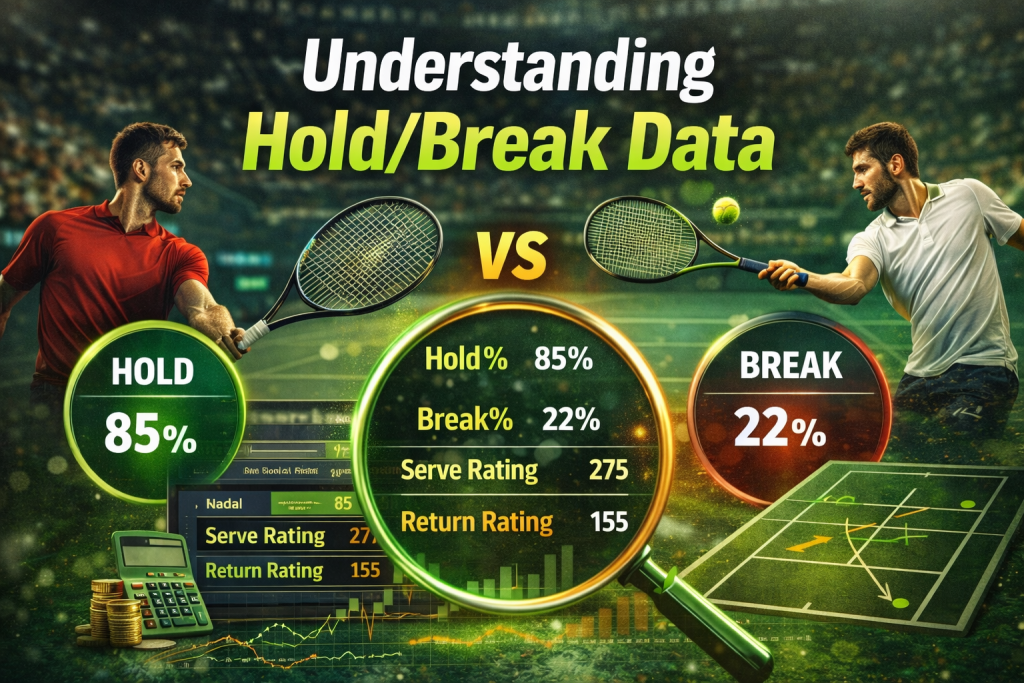
Service hold and break percentages are among the most powerful metrics in tennis analysis, yet they are often misunderstood or

One of the most common debates in tennis betting is whether greater edge exists pre-match or in-play. The answer is

In tennis betting, long-term success is not about picking winners; it is about identifying value. A value bet exists when