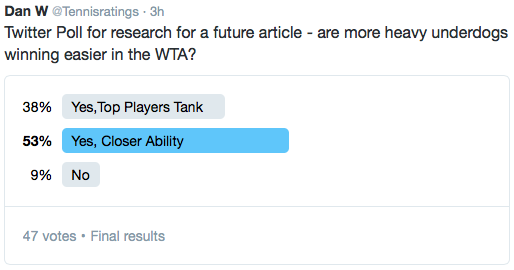
We can see that firstly, 91% of the voters on Twitter suggested that more heavy underdogs were winning easier than previously – a clear example of ‘Gambler’s Fallacy’ (a situation where people remember notorious events and think they occur more frequently than they actually do). In effect, these 91% of people (and myself, as I would have voted for option 1 – there are more tanks) were wrong based on the six players above. However, they may actually have a valid point, which I will discuss shortly.
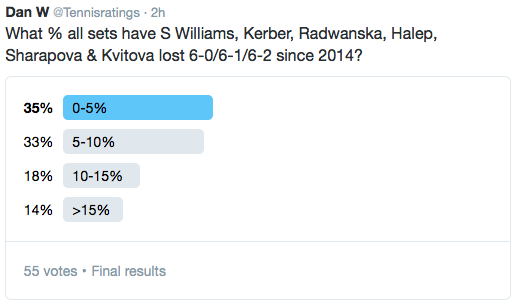
Secondly we can see that with 35% vote share, 0-5% of sets were thought to have been lost by 6-0/6-1/6-2 by the six players mentioned, with the actual correct answer, 5-10% coming in slightly behind, at 33%.
Using the midpoints of these brackets (and 17.5% for the final bracket), an expectation of 8.05% was generated by these poll results, very similar to the overall 8.74% figure. So perhaps the World of Twitter is extremely efficient!
Several paragraphs ago, I mentioned that Twitter could actually be correct in thinking that life was easier for heavy underdogs against top players than several years ago. If we look at the WTA top 10 in June 2014, the midpoint of the 2014 season, we can see that Li Na, Jelena Jankovic, Dominika Cibulkova and Victoria Azarenka were in the top ten – all players with strong return games and high deficit recovery percentages. Ana Ivanovic and Sara Errani, also players with very high deficit recovery percentages, were also just outside the top 10, showing that in June 2014, the top of the women’s game was littered with players who were superb at recovering deficits in matches.
The inclusion of Victoria Azarenka in the top 10 in June 2014 helped to boost the deficit recovery stats of the top 10…

By definition, this would mean that top players would tank less and fight more, and heavy underdogs would actually find it tougher to finish off ‘better’ opponents.
Instead of this, these players have now been replaced by worse versions of Halep and Kvitova, and Angelique Kerber. The stats in the first table show that Kvitova and Kerber frequently check out of sets and lose them by double break margins more than their peers, whilst Halep’s recent form has declined sharply, contributing to her poor numbers.
Petra Kvitova lost a 6-0 to 6-2 set a very poor 10.55% from 2014 to the date of this article…
We can see that the two players with the best deficit recovery stats – Serena Williams & Maria Sharapova – showed the lowest percentage of dominant set defeats, indicating that there is a clear relationship between deficit recovery and an ability to at least keep sets close when losing them, a key attribute required for traders who are laying the player a break up in a set.
So to conclude, it’s reasonable to say that the dynamic of top WTA players has changed. It is no longer one that is heavily return/deficit recovery orientated – it appears that these are players who are more inclined to front-run and win on their terms.